








Where to find diamonds in Minecraft: the best Y level
Go to Y -59, dig 2-block-high branch tunnels and use Fortune III: the exact diamond layers, a mining layout and lava safety for Java Edition.
On this page · 5
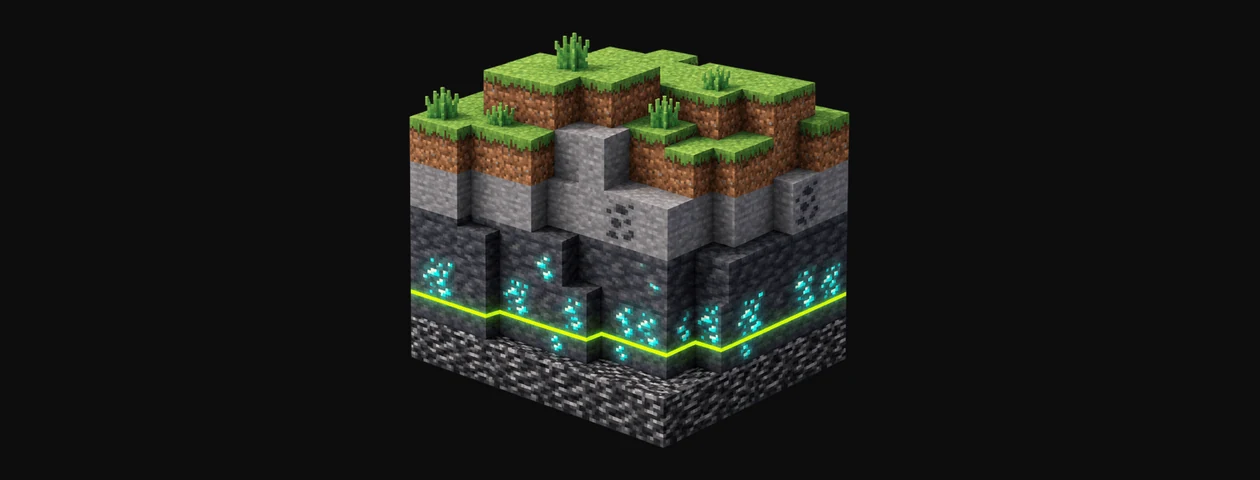
Diamonds are most common at Y -59, just above the bedrock. Go to that layer, dig long tunnels instead of exploring caves, and keep a water bucket ready for lava.
Bring an iron pickaxe or better
Diamond Ore only drops a Diamond when you break it with an Iron Pickaxe, a Diamond Pickaxe or a Netherite Pickaxe. A Stone Pickaxe, Copper Pickaxe, Golden Pickaxe or Wooden Pickaxe breaks the block but drops nothing.
Also pack:
- a Water Bucket against lava,
- a stack of Torches to light the tunnels,
- food and a few spare blocks to seal off lava.
Go down to Y -59
Press F3 and read the Y value in the XYZ line: it is the height of your feet. In Java Edition 26.3, diamond ore generates from Y -64 to Y 16 in every Overworld biome, and it gets more common the deeper you go. Bedrock fills Y -64 to -60 irregularly, so Y -59 is the first clean layer and the peak. Anything between Y -60 and Y -38 is still a good layer.
Below Y 0, the underground is Deepslate (stone and deepslate mix between Y 0 and Y 8), so most of your finds will be Deepslate Diamond Ore. It drops the same diamonds, but deepslate breaks more slowly than stone.
Redstone Ore peaks at the same layer, so one trip fills both. Compare the two curves in the explorer below.
Ore explorer: the best Y level for each ore
Pick one or more ores. The chart shows how many ore blocks generate at each layer, from the bottom of the world to the top.
Turn on JavaScript to use the interactive version.
Move over the chart to read a layer
| Ore | Best layer | Good between | Found between |
|---|---|---|---|
 Coal | Y 62 | 50 → 62 | 0 → 62 |
| CoalMountains | Y 136 | 136 → 162 | 0 → 319 |
 Copper | Y 48 | 36 → 60 | -16 → 62 |
| CopperDripstone Caves | Y 48 | 35 → 61 | -16 → 62 |
 Iron | Y 16 | 8 → 24 | -63 → 62 |
| IronMountains | Y 232 | 202 → 262 | -63 → 319 |
 Gold | Y -16 | -25 → -7 | -63 → 32 |
| GoldBadlands | even spread | 32 → 120 | -63 → 120 |
 Redstone | Y -59 | -60 → -53 | -63 → 15 |
 Lapis lazuli | Y 0 | -9 → 9 | -63 → 62 |
 Diamond | Y -59 | -60 → -38 | -63 → 16 |
 EmeraldMountains | Y 232 | 183 → 281 | -16 → 319 |
 Nether quartz | even spread | 10 → 123 | 10 → 126 |
 Nether gold | even spread | 10 → 123 | 10 → 126 |
 Ancient debris | Y 16 | 15 → 17 | 8 → 126 |
Calculated from the Java Edition 26.3 game filesExpected blocks before caves and air pockets: some veins next to air are skipped, so real counts are a bit lower. The shape and the best layer do not change.
Dig branch tunnels instead of exploring caves
Diamond veins that touch air lose blocks during world generation. Small and medium veins skip 50% of the blocks that would touch a cave, large veins skip 70%. A fourth type, the buried vein (4 per chunk), never places a single block next to air. Caves therefore show you only part of the diamonds; the rest sits in solid rock.
Branch mining reaches those hidden veins:
- Dig a main tunnel 2 blocks high at Y -59.
- Every 3 blocks, dig a side branch 2 high, 1 wide and about 32 blocks long.
- This leaves 2 blocks of rock between two branches. Each of those blocks touches a tunnel, so you see every block.
- Check both walls, the floor and the ceiling as you go.
Watch out for lava at the bottom of the world
During world generation, caves and ravines between Y -63 and Y -55 are filled with lava instead of air. At Y -59 you are inside that zone: any block you break can open a lava lake.
- Dig a staircase down, never straight down.
- When lava shows up, place a block in the hole at once.
- Keep the Water Bucket in your hotbar: water poured on a lava source turns it into Obsidian.
- Items that fall into lava burn, diamonds included.
Mine the ore with Fortune III
Without enchantments, each Diamond Ore drops 1 diamond and 3–7 experience points. Fortune III multiplies the drop: 40% chance of 1 diamond and 20% each for 2, 3 or 4, so 2.2 diamonds per ore on average. Fortune I averages 1.33, Fortune II 1.75.
Silk Touch drops the ore block itself instead. That is useful while you have no Fortune pickaxe yet: keep the ore blocks and break them later with Fortune III. Fortune and Silk Touch cannot be on the same pickaxe.
Tip: explosions destroy part of the drop of diamond ore, so never use TNT to mine diamonds.
FAQ
Is Y -58 or Y -59 better for diamonds?
Both are fine. Stand at Y -59: a 2-block-high tunnel then covers Y -59 and Y -58, and you also see Y -60 in the floor and Y -57 in the ceiling.
Can diamonds generate above Y 16?
Not as ore: in Java Edition 26.3 no diamond ore generates above Y 16. Higher up, diamonds come only from loot chests, for example in village toolsmiths, shipwrecks, buried treasure or desert pyramids.
Does Fortune work on Deepslate Diamond Ore?
Yes. Deepslate Diamond Ore uses the same drop rules as normal diamond ore, so Fortune III averages 2.2 diamonds and Silk Touch drops the block.
Are diamonds at the same height in Bedrock Edition?
Yes. Bedrock Edition uses the same diamond generation since the Caves & Cliffs update (1.18), so Y -59 is the best layer there too.
Blocks & items in this guide
20 · recipe, drops and data for each Diamond
 Lava
- Diamond Ore
 Water Bucket
 Deepslate
 Bedrock
 Stone
 Iron Pickaxe
 Diamond Pickaxe
 Netherite Pickaxe
 Stone Pickaxe
 Copper Pickaxe
 Golden Pickaxe
 Wooden Pickaxe
 Torch
 Deepslate Diamond Ore
- Redstone Ore
 Water
 Obsidian
 TNT