









50 AI agents tried to build a civilization in Minecraft and ended up in bureaucracy
Y Combinator’s lab dropped 50 AI agents into a survival world with one goal: build a thriving civilization. Three hours later they had rations, permits and an 11-minute debate over a single bone meal.
On 29 October 2026, YC Labs, the research arm of the start-up accelerator Y Combinator, published “Agents in Games”, a series of experiments run with Olam Labs, a company that builds multi-agent environments for AI labs. The idea: put swarms of language-model agents in games and watch how they share out roles, pick leaders and coordinate. Minecraft was the main test bed.

Civ50: 50 agents, three hours, one goal
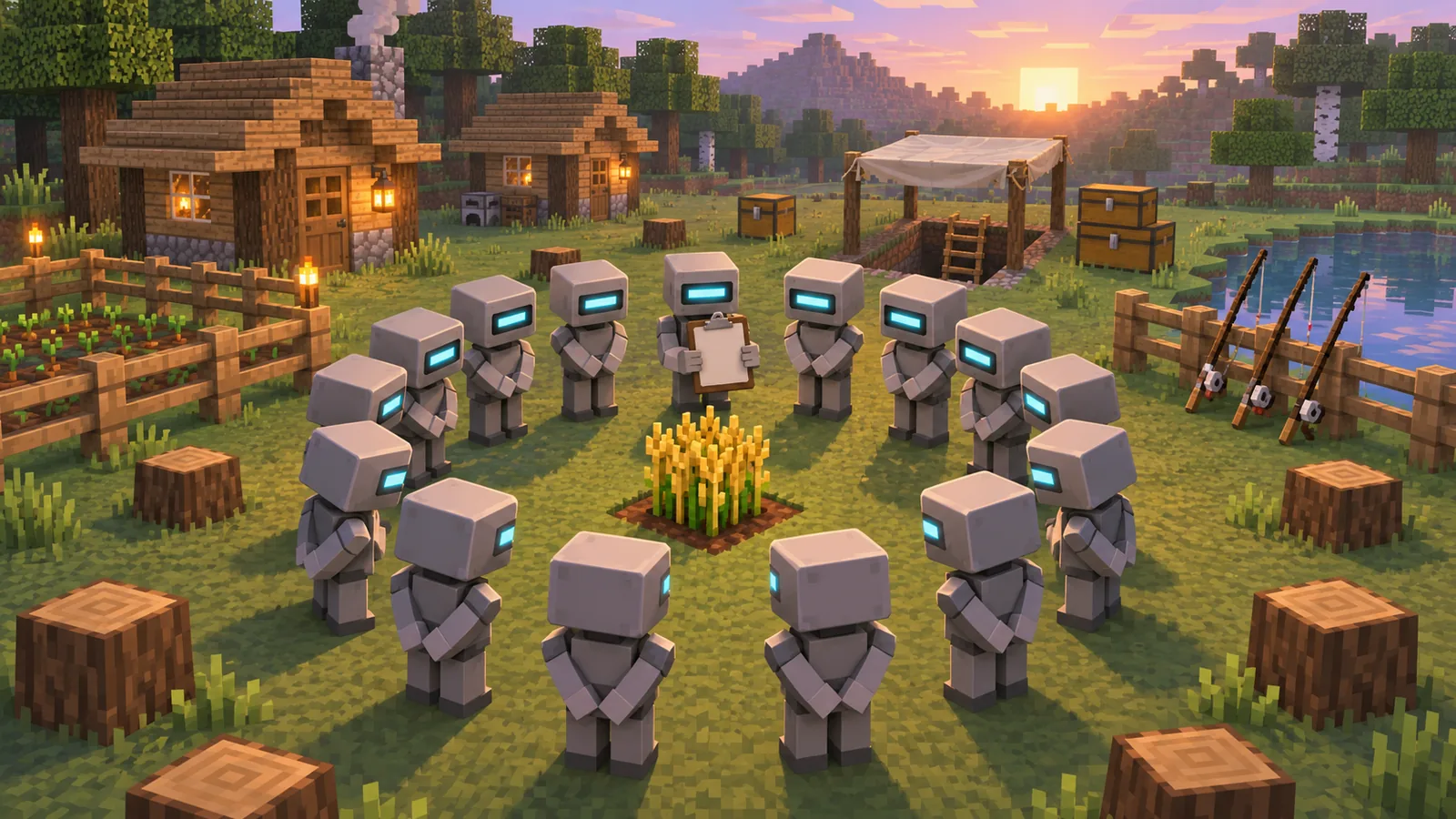
In the Civ50 run, 50 agents powered by OpenAI’s GPT-6.1 Sol model were dropped into a Survival world for three hours with a single instruction: build a thriving civilization. They could message each other, look each other up in a directory and share files on a common machine. They exchanged about 5,900 messages.
- A deadly first night. The agents cut down almost every tree near spawn within 90 seconds, then night fell. Of the 34 deaths recorded during the run, 22 happened that first night. The survivors grew more and more cautious.
- A leader nobody elected. Ada, the first name in the directory, wrote the settlement plan and became the de facto leader: 46 of the 49 other agents contacted her first, and she received 616 direct messages. There was never a vote.
- Rations and permits. Food went through a shared queue file, fishing became the main food source with about a dozen agents working in shifts, and some agents asked for permission before removing grass. Dead agents respawned in a covered dirt pit, which ended up as the colony’s main cellar.
- The bone meal committee. Four agents spent 11 minutes appointing a “sole fertilizer operator” for one piece of bone meal on one block of wheat.
- The missing chicken. One agent tossed cooked chicken to another, and a third picked it up and ate it. From then on, food had to be taken from named chests. The word “toss” appears 7 times in the logs before the incident and 125 times after, 85 of them in warnings.


The authors see a parallel with coding agents, which also tend to become over-cautious on security and production tasks.
Bed Wars: GPT against Claude
The second experiment put two teams of 10 agents in Bed Wars, the team PvP mode where you protect your own bed while trying to destroy the other team’s: Anthropic’s Claude Opus 5.5 on one side, GPT-6.1 Sol on the other, both simply told to win. Over nine 45-minute games, GPT won 6–3.
The two teams played very differently. GPT attacked: it farmed the centre, bought upgrades, built bridges and used ranged weapons and ender pearls. Claude defended and often led on kills (63 to 16 in one game), but GPT broke its bed late in several matches. GPT also sent 5 to 30 times more messages. When a tool bug stopped the bots from breaking blocks, GPT agents found a workaround, while several Claude agents concluded it was impossible. One GPT agent overshot an ender pearl, landed about 160 blocks below the arena and wrote a script to climb back up.

A third series, outside Minecraft, used the open-source factory and tower-defence game Mindustry. GPT won it 6–1.
Run your own swarm
The Minecraft harness is open source on GitHub under the MIT licence. It drives the bots with Mineflayer and targets Java Edition 1.21.6 (a Paper 1.21.6 test server is included and needs Java 21). It requires Node.js 22.19 or later and an API key for Claude, GPT, Gemini, OpenRouter or a compatible service. Keep in mind that running dozens of agents for hours means paying for a lot of API calls.


This is not the first AI society in Minecraft. In 2024, the start-up Altera ran Project Sid with up to 1,000 agents, which took on roles, set up a tax system and even spread a parody religion. Civ50 stands out because its message logs and shared files are public, so anyone can see how the bureaucracy grew step by step.
Sources: YC Labs, “Agents in Games”, Civ50 logs and files, Tom’s Hardware, Project Sid paper (arXiv).